
Small Business Accounting: Using a Cash Flow Statement

A cash flow statement is one of the three core financial statements a small business needs. It tracks the actual cash moving in and out of your business across three areas—operations, investing, and financing—over a set period. Unlike a profit and loss statement, it shows whether you have the cash on hand to cover payroll, bills, and growth.
Understanding and managing cash flow is critical to any small business’s success. That’s why a cash flow statement is essential for small business accounting.
Along with the balance sheet and income statement, a cash flow statement is one of the three primary financial statements that all businesses need. We’ll break down the differences among these statements below. But first let’s dive into what the cash flow statement tells you, how to use it to analyze your business’s performance, and how it can help you identify any cash flow problems.
What Does a Cash Flow Statement Show?
A cash flow statement shows a company’s cash transactions within a specified period. Many small business owners make the mistake of focusing only on profit and loss. But the cash flow statement shows where money is coming from and how it’s being spent, which can help you make better business decisions. The cash flow statement is also essential for investors, as it measures financial health.
The cash flow statement reports cash inflows and outflows for business operations, investments, and financing. Net cash flow is the sum of those three, and below is a description of what each section covers.
Cash flow from operations
This part of a cash flow statement covers the cash flow from operating activities. This includes buying and selling inventory and supplies, salaries, office space rent, income tax payments, and all other operational expenses.
Cash flow from investing
Cash flow from investing includes changes in cash, referred to as cash out or cash in, representing long-term or short-term investments in the company’s growth. This could be purchasing or selling equipment, real estate, vehicles, patents, and other assets a company uses or could sell.
Cash flow from financing
Cash flow from financing summarizes the sources of cash from investors and banks, as well as the cash paid to shareholders. This includes cash obtained or paid back from capital fundraising efforts, dividends paid to investors, payments for stock repurchases, and loan repayments. Its source is typically from debt or equity.

How to Use a Cash Flow Statement
The cash flow statement is used not only to show the amount of cash generated and spent over a specific period but also to analyze a business’s liquidity and long-term solvency. The summary of all cash transactions will show either a positive or negative cash flow.
Positive cash flow means more money is coming in than going out. However, a positive cash flow does not always indicate that the business is profitable. It could have a positive cash flow from borrowing activities but a negative net income. Still, whenever a business shows a positive cash flow, excess cash could be reinvested in the business’s growth.
A negative cash flow means more cash is going out than coming in. That’s sometimes a good thing, especially if it’s due to investments in future growth. However, negative cash flow over several accounting periods could be a red flag for the company’s financial health.
How to Identify Cash Flow Problems
The cash flow statement is a critical tool for managing a company’s cash flow and ensuring that it has sufficient liquidity to meet its short-term obligations, such as payroll and other ongoing expenses.
Analyzing incoming and outgoing cash transactions helps a small business owner make informed decisions. It also helps you anticipate problems, whether having funds to pay off debts or determining eligibility for a business loan.
The cash flow statement also helps your business maintain its optimum level of cash on hand. If you discover that money is idle, it means your business could use those funds for growth, like purchasing more inventory or hiring staff. But if the cash flow statement shows a cash shortfall, you may need to borrow money or cut expenses to keep the business afloat until it can turn a profit.
For Oregon businesses, cash flow planning should also account for tax obligations that come due regardless of profitability. The Oregon Corporate Activity Tax (CAT), for example, is a gross receipts tax, meaning a business with more than $1 million in Oregon commercial activity may owe it even if it posts a net loss in that year.
Because it’s tied to revenue rather than profit, the CAT can come due even in a lean year. Oregon business owners should set aside cash for it—and for quarterly estimated taxes—throughout the year, rather than scrambling when payments are due.
How Do You Calculate Cash Flow?
Cash flow is calculated using either the direct or indirect method. Both methods tell the same story of how cash flows through the business, but each does it from a different starting perspective.
Direct cash flow method
Using the direct cash flow method, you would subtract all cash payments made to suppliers and employees, as well as other operating and customer receipts, from a specified accounting period. This gives the net cash outflow from the company’s operating expenses. Investing and financing activities are included after the operations net cash flow to calculate the net change in the company’s cash flow for that period.
The direct cash flow method uses real-time figures to show actual payments and receipts. It’s simple to understand but can be complex to calculate because it requires a list of all cash receipts and disbursements, which can be time-intensive to compile. Small businesses with fewer cash transactions typically use the direct cash flow method.
Indirect cash flow method
The indirect cash flow method shows how much cash the business spent or made during the accounting period. It takes the company’s net income and adds or subtracts differences from noncash transactions, including changes in current liabilities, assets, and other sources on the balance sheet, like nonoperating losses or gains from noncurrent assets.
The indirect cash flow method adjusts for nonoperating expenses to determine cash flow from operating activities. Examples of these adjustments are adding the decrease in accounts receivable, deducting the decrease in accounts payable, or deducting the increase in inventory.
Public companies often use the indirect cash flow method. Because it uses information from income statements and balance sheets, it’s quick to calculate and comes in handy for audits.
How a Cash Flow Statement Differs from Other Financial Statements
The cash flow statement measures your business’s performance over a period of time by reporting its cash inflows and outflows. Its bottom line shows the net increase or decrease for that accounting period.
The income statement, also known as a profit and loss statement, shows how much money the business made and spent over the accounting period, as well as the costs and expenses associated with earning that income. Its bottom line shows the company’s net earnings or losses for that period.
A balance sheet shows what a business owns and owes at a fixed point in time. It includes detailed information on the company’s assets, liabilities, and shareholders’ equity. The balance sheet uses the equation Assets = Liabilities + Shareholders’ Equity. So its assets have to equal (or balance) the sum of its liabilities and shareholders’ equity.
| Financial statement | What it measures | Time frame | Bottom line |
| Cash flow statement | Actual cash flowing in and out | Over a period | Net increase or decrease in cash |
| Income statement | Revenue earned and expenses incurred | Over a period | Net profit or loss |
| Balance sheet | What the business owns and owes | A fixed point in time | Assets = Liabilities + Equity |
How the financial statements relate
Each financial statement shows a different picture, but they’re all related. For instance, the changes in assets and liabilities shown on the balance sheet are also reflected in the revenues and expenses on the income statement, reflecting the business’s gains or losses.
The image below is courtesy of the Corporate Finance Institute.
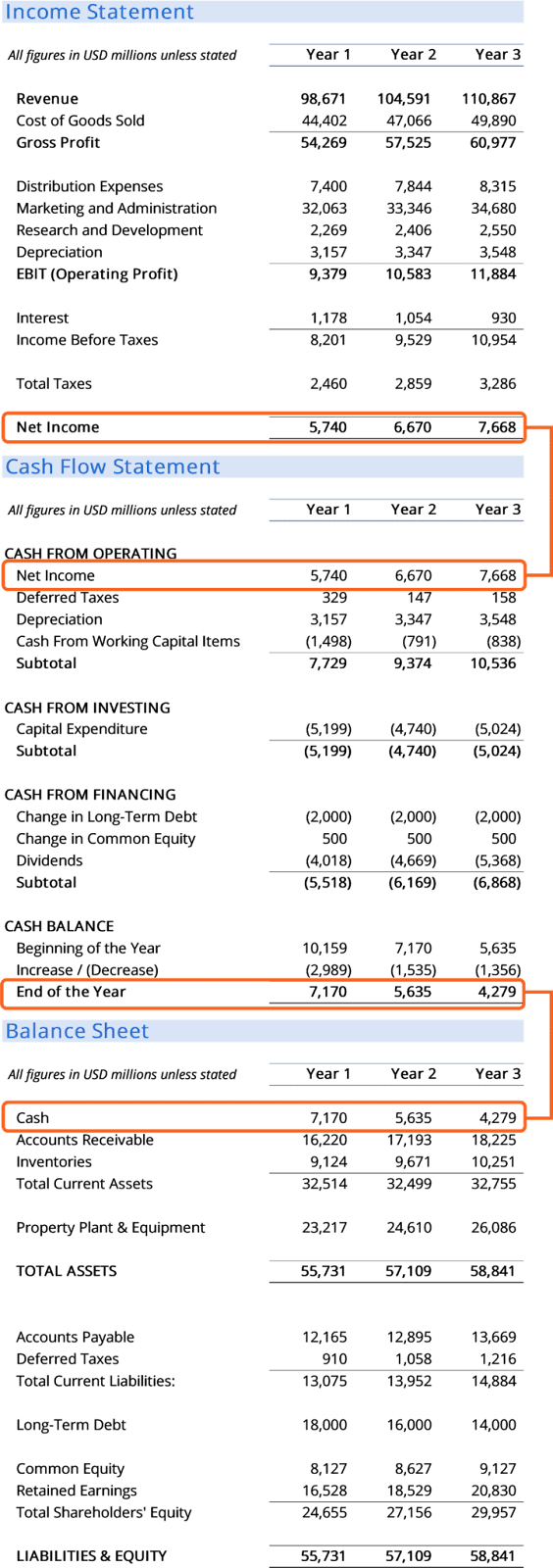
Cash flow statements provide more information on the cash assets listed on the balance sheet. They’re related, but not equivalent, to net income shown on the income statement, and so on.
When all three of these financial statements are combined, they provide a complete picture of a company’s financial standing. They also come in handy when preparing your tax returns.
The Oregon SBDC Network provides classes on small business accounting methods, cash flow management, budgeting, and QuickBooks Online (from Intuit), a cloud-based accounting app that many small businesses favor.
To find a small business accounting or QuickBooks class near you, contact your local Center today.
Frequently Asked Questions
What are the sections of a cash flow statement?
A cash flow statement is divided into cash flow from operations (day-to-day business activity), cash flow from investing (buying or selling long-term assets like equipment or property), and cash flow from financing (money from loans, investors, or paid out as dividends and loan repayments). Added together, these three sections give you your net cash flow.
What’s the difference between the direct and indirect cash flow methods?
The direct method adds up actual cash payments and receipts during the period, giving a real-time picture that’s simple to understand but time-consuming to compile. The indirect method starts with net income and adjusts for noncash items using figures from your income statement and balance sheet. Smaller businesses often use the direct method; larger and public companies typically use the indirect method.
Does positive cash flow mean my business is profitable?
Not necessarily. A business can show positive cash flow while still posting a net loss—if the cash came from borrowing rather than sales, for example. Cash flow measures liquidity (whether you have cash on hand), while profit is measured on the income statement. That’s why reviewing all three financial statements together gives the clearest picture.
Which cash flow method should a small business use?
Most small businesses with a manageable number of transactions use the direct method because it’s straightforward and reflects actual payments and receipts. As a business grows or needs to reconcile against its income statement and balance sheet for audits, the indirect method often becomes more practical. Your accountant can help you decide which fits.


Subscribe for more Oregon SBDC Small Business Tips
All fields marked with * are required.
By submitting this form, you are consenting to receive marketing emails from: Oregon Small Business Development Center Network, 4000 East 30th Ave., Eugene, OR, 97405, http://www.oregonsbdc.org. You can revoke your consent to receive emails at any time by using the SafeUnsubscribe® link, found at the bottom of every email. Emails are serviced by Constant Contact